The Astoria City Council received a citizen initiative petition to establish a “Vacant Rental Unit Excise Tax.” This is now ballot measure 4-247, City of Astoria initiative “Vacant Home Tax” and will be on the 3 November 2026 ballot. The petition and effort is supported by the Astoria Housing Alliance (AHA).
The proposed ordinance would add a new chapter to the Astoria city Code establishing a Vacant Residential Excise Tax and creating a “Community Housing Fund.”
From the City of Astoria ‘s “Summary of Proposed Initiative”:
- Establish a Vacant Unit Excise tax applicable to residential units that do not meet specified occupancy thresholds (less than 183 days) during a calendar year. The ordinance characterizes the tax as an excise tax on “taxable vacancy” conduct vs a tax on property ownership.
- Establish tax rates of $3,000.00 (year one) and $6,000.00 (year two and beyond) effective January 1 2027.
- Defines qualifying residential uses, vacancy exclusion periods and exemptions including medical care, military service, disaster recovery, permitted rehabilitation, government ownership and nonprofit organizations and financial hardship.
- The community wide fund funds the following: affordable workforce housing development, acquisition, rehabilitation, housing assistance programs, tenant support services and administration of the program.
This ballot measure – if passed – presents numerous issues to homeowners, including:
- Government overreach retroactively dictating how & when you use your private property or incur fines;
- Can be expected to be tied up in expensive and lengthy litigation;
- Invasion of privacy – requires paper reporting to city by all property owners, data unsecured, possible FOIA release of where a homeowner is living & when;
- Creates division in the community;
- No exceptions for traveling professionals (Maritime, Medical, Airline, Trades)
- City must bear initial program costs for first 22 months of inception including salary, admin, overhead and legal costs;
- Assumes residents who occupy their homes under 183 days do not contribute to community & impose “community-wide costs” and
- Initiative will not increase housing stock.
From AHA Frequently Asked Questions:
“Clatsop county housing data estimates there were 669 vacant or seasonally occupied homes in Astoria in Astoria in 2024. Not all of these will be taxable under the proposed ballot measure, as the specific circumstances of each unit are not known. But it’s reasonable to assume that many will”.
The Astoria Housing Assessment (based on the Clatsop County study, shown below) stated Astoria Vacancy by subcategory and shows vacant homes at 219 units.
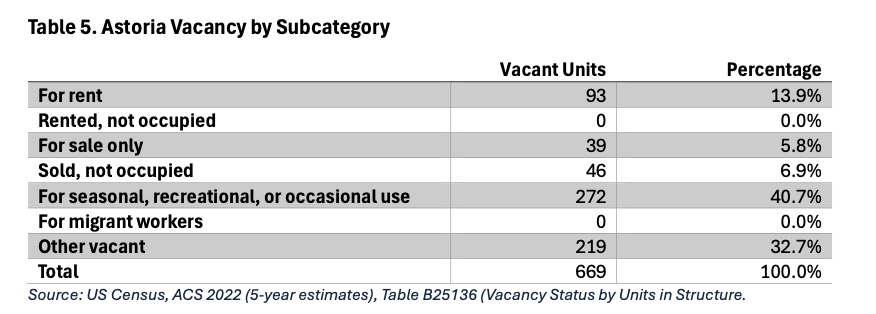
Excerpts From Astoria Housing Alliance Frequently asked questions:
FAQ: “If it’s your principal residence—the place you actually live for at least six months of the year—then being away on vacation doesn’t make it vacant. The home is still your principal residence. This tax targets homes that sit empty with no one living in them, not people’s primary residences when they’re away on trips.”
This is not stated in the proposed ordinance.
FAQ: “It’s a good idea to keep basic records for your own reference. You self-report on your annual Tax declaration. If there’s every been a question about your occupancy document like utility bills, rental agreements, or rental listings can help clarify the situation.”
Forces homeowners to document where there’re living and when.
FAQ: “If your Astoria home is still your principal residence—where you intend to return and live for at least six months of the year—being away for work doesn’t make it vacant.
But if you’ve effectively moved elsewhere and the Astoria home sits empty more than 182 days, it would be considered vacant. Military service members and firefighters/emergency responders have special protection—their days away don’t count as vacant.”
The FAQs specifically state the following exemptions: “Medical Care, Military Service, Disaster Recovery, Owner Death, Financial Hardship, Firefighter or other emergency service worker services.” No mention of employment exemptions for workers including Maritime, Medical, Airline, Trades among others.
FAQ: “The tax is due payable by October 31 of the year following the tax year (or 30 days after you receive the Notice of Tax Due, whichever is later). Late payments are subject to a 10% delinquency penalty plus interest at 1.5% per month. The City can pursue collection through civil action if necessary. Penalty for falsifying a Tax Declaration is 100% of the unpaid taxes for that year. If an owner knowingly submits a materially false tax declaration for any tax year, a penalty equal to 100% of the unpaid tax for that year, exclusive of interest, shall be imposed in addition to any other penalties authorize by this chapter.”
In addition to a $3k penalty (year one) and/or a $6k penalty (year two and beyond), a false statement doubles those fines.
Additionally, in a February 27, 2026 article published by 1000 Friends of Oregon titled “Astoria residents launch bold new initiative to fund community housing.” The article discusses the Astoria Housing Initiative, including the proposed Empty Homes Tax.
Near the end of the article, 1000 Friends of Oregon states:
“If Astoria’s initiative passes, it may set a precedent for other cities in Oregon whose housing markets are heavily impacted by tourism and second home ownership.”
The article continues by saying that many cities are looking for creative ways to fund housing and infrastructure and that the Astoria measure “could be a promising tool in cities’ toolkits.”
We are deeply concerned about this ballot measure and the impact on Astoria. This is the opposite of “neighborly” and “community”. It encourages neighbors to spy on neighbors – we’ve already seen their promotional material placed on homes that owners have vacated to sell. Those materials – placed on the entryway to vacant homes – state “Empty Homes Don’t Build Community” and provide notification that a house is empty – exposing the property to possible theft and squatting.
Is this what our future looks like in Astoria? This is not an effective housing supply solution and will not increase housing stock – but may produce numerous unintended consequences.
We – as a community that cares – need to fight this ballot initiative to ensure it does not pass.
Additional Resources:
 VOTE NO VACANT HOME TAX